Architecture
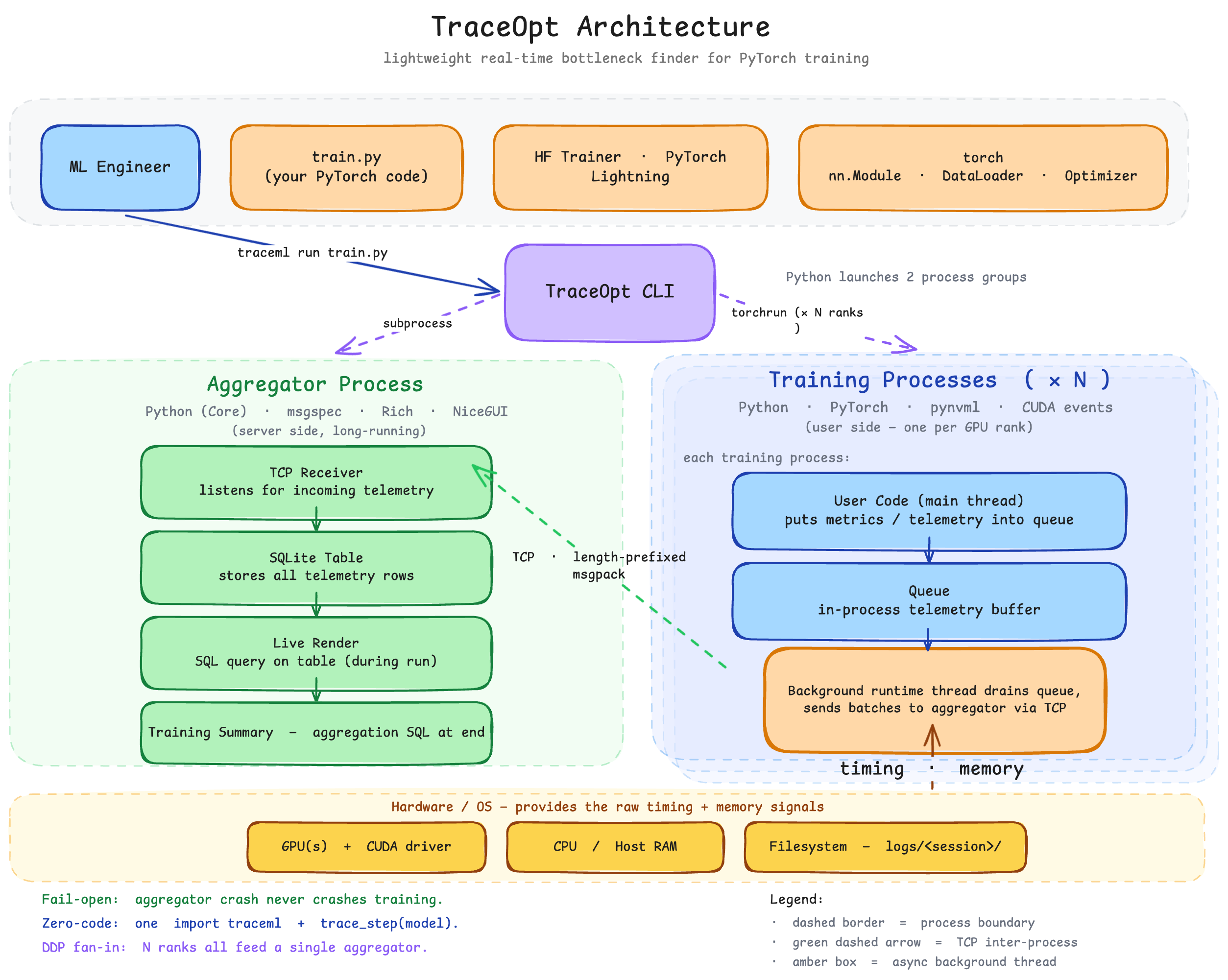
TraceML runs as three cooperating processes during a training job. The CLI spawns an aggregator server and one or more training ranks via torchrun. Training ranks run user code in-process with TraceML hooks attached; telemetry is shipped over TCP to the aggregator, which renders the unified view.
Telemetry data flow
flowchart LR
    subgraph "Per-rank training process"
        S[Sampler] -->|append| DB[In-memory Database]
        DB -->|new rows| Sender[DBIncrementalSender]
    end
    Sender -->|length-prefixed msgpack| TCP([TCP])
    subgraph "Aggregator process"
        TCP --> H[SQLite history]
        H --> R[Renderer]
        R --> UI[CLI / NiceGUI driver]
    end
Samplers maintain an incremental append counter per rank per table. The sender ships only new rows. The aggregator writes canonical telemetry into SQLite-backed history, and renderers pull read-only views from that history.
Layers
| Layer | Directory | Responsibility |
|---|---|---|
| CLI | src/traceml_ai/launcher/ |
Argument parsing, process spawning, signal handling |
| Runtime | src/traceml_ai/runtime/ |
In-process agent per rank; user-script executor |
| Aggregator | src/traceml_ai/aggregator/ |
TCP server, unified store, display orchestration |
| Samplers | src/traceml_ai/samplers/ |
Periodic telemetry collection (timing, memory, system) |
| Database | src/traceml_ai/database/ |
Bounded in-memory tables and SQLite-backed history |
| Transport | src/traceml_ai/transport/ |
TCP bidirectional + DDP rank detection |
| Step Time domain | src/traceml_ai/step_time/ |
Shared contracts and set-based SQLite source repository |
| Renderers | src/traceml_ai/renderers/ |
Transform stored data into Rich/Plotly output |
| Display drivers | src/traceml_ai/aggregator/display_drivers/ |
CLI vs NiceGUI output medium |
| Public API | src/traceml_ai/api.py |
Top-level instrumentation entry points |
| Integrations | src/traceml_ai/integrations/ |
Hugging Face, Lightning, and Ray adapters |
| Utils | src/traceml_ai/utils/ |
Hooks, patches, memory/timing helpers |
For the user-facing API surface (trace_step, TraceMLTrainerCallback, TraceMLCallback, CLI usage), see the Public API. The source tree above is the canonical reference for internals — start from the entry points and follow the imports.
Contributors changing Step Time should begin with the
Step Time pipeline contract, which maps its
canonical window, diagnosis, live surfaces, final-summary projection, and
cross-surface fixtures without requiring a full source-tree traversal.
Shared Step Time types belong in traceml_ai.step_time.model; that module must
not import SQLite, diagnosis, reporting, or UI code.
Design principles
- Fail-open — training must never crash because telemetry broke. Sampler/transport errors are logged, execution continues.
- Bounded overhead — every new sampler justifies its overhead. Deque-based bounded tables evict oldest records at fixed
maxlen. - Process isolation — no shared memory. TCP + env vars only.
- Out-of-process UI — aggregator crashes don't crash training.
Architecture decisions
The load-bearing calls that shape the system, with the rationale and the main alternative that was rejected. Smaller choices live in code comments and pull requests.
| Decision | Rationale (alternative rejected) | Consequence / trade-off |
|---|---|---|
| Run the aggregator out-of-process and talk over TCP | A crash or slowdown in the UI/diagnosis layer must never take down training (rejected: in-process aggregation sharing the training interpreter) | A serialize-and-send hop per batch, plus an env-var contract and a fixed port to manage |
Auto-instrument by patching PyTorch internals at init() |
Deliver phase timing with zero manual logging (rejected: asking users to wrap every phase by hand) | Tight coupling to torch internals (nn.Module.__call__, Tensor.backward / autograd.backward, Tensor.to, DataLoader.__iter__); patches must be fail-open and are the most test-critical surface |
Time GPU phases with pooled CUDA events resolved by non-blocking query(), never synchronize() |
Synchronizing to read a timing would stall the training stream and distort the very thing being measured (rejected: torch.cuda.synchronize() around phases) |
Events resolve opportunistically from a capped pool; an occasional unresolved event is dropped (overhead safety chosen over total completeness) |
| Length-prefixed msgpack frames, no version field, legacy flat shape still accepted | Keep the wire compact and simple while preserving existing v0.2.x senders (rejected: a versioned/handshaked protocol) | Wire evolution must stay additive and tolerant; there is no negotiated version to branch on |
| Bounded in-memory deque tables for the live view, SQLite (WAL) for history | Cap per-rank memory yet keep a queryable history; renderers read from SQLite (rejected: unbounded in-memory retention) | Oldest in-memory rows evict at maxlen; SQLite retention advances only through the minimum Step Time/Step Memory step that is aligned across all ranks and older than history_retention |
| Rule-based diagnosis: stateless per-window thresholds, min-step damping, no hysteresis | Verdicts must be explainable, deterministic, and cheap, with no training data required (rejected: a learned/ML classifier) | Thresholds are hand-tuned and documented; verdicts are named (INPUT_BOUND, COMPUTE_STRAGGLER, CREEP_CONFIRMED, and so on) |
Report residual time as a derived bucket: residual = max(0, Traced Step Time - h2d - forward - backward - optimizer) |
No portable, in-process, cross-backend hook for collective/NCCL time exists today (rejected: backend-specific collective instrumentation) | Residual time can absorb legitimate non-collective gaps; explicit collective timing is on the roadmap and flagged in the user docs |
| Lazy imports for UI and integrations | import traceml_ai should stay fast and avoid importing torch, NiceGUI, Plotly, or framework stacks until a feature needs them (rejected: eager imports of the UI/integration stack) |
Summary is the default display mode. NiceGUI stays behind the dashboard extra, while framework stacks stay behind their extras or integration-specific installs |
Quality requirements
| Quality attribute | Requirement | How it is met |
|---|---|---|
| Safety (non-intrusion) | Instrumentation must never crash training and must never swallow a user exception | Every sampler and transport path is fail-open: errors log to stderr with a [TraceML] prefix and execution continues; the runtime degrades to a NoOpRuntime if boot fails |
| Low overhead | Lightweight enough to leave on for a full production run | Non-blocking CUDA timing (no synchronize()), bounded deque tables, one roughly 1 Hz sampler thread per rank, one msgpack batch per tick. Relative overhead is highest on very short steps and amortizes on long ones. A formal cross-configuration overhead benchmark is in progress and not yet published. |
| Local-first | Core functionality works offline, no account required | Collection, display, diagnosis, and final_summary writing all run locally; cloud is additive, never required |
| Bounded resource use | Memory and disk must not grow without limit during a long run | In-memory tables are deque-bounded; indexed SQLite pruning runs at most once per minute and at finalization, deleting step history through one shared aligned frontier and periodic history through the same timestamp; later arrivals at or before a deleted boundary are dropped before insertion |
| Backward compatibility | Existing v0.2.x senders and saved outputs keep working | The wire accepts the legacy flat envelope; compare and inspect read saved summary JSON and msgpack logs without a live run |
| Explainability | A diagnosis must be traceable to the numbers behind it | Verdicts are named, threshold-based, and deterministic per window, not opaque scores |
| Portability | Run on the common training setups | Python 3.10+, Linux/macOS/Windows launcher, PyTorch 2.x, single and multi-rank via torchrun including multi-node |
Risks and technical debt
Architectural risks and known structural debt. Day-to-day bugs live in the issue tracker; this is the design-level set.
- PyTorch-internals coupling. Auto-instrumentation patches torch internals that can change between releases, so a torch upgrade is the most likely source of a silent metric regression. Mitigation: the patches are fail-open and instrumentation is the most heavily tested surface in the codebase.
- Residual time is a proxy, not a measurement.
residualis what remains after h2d, forward, backward, and optimizer are subtracted from step time, so it can include real non-collective gaps. There is no explicit collective/NCCL timing yet; adding it is the main planned step toward distributed defensibility. - No version field on the wire. Backward compatibility relies on tolerating the legacy envelope shape rather than negotiating a version, so any non-additive wire change needs an explicit migration path.
- Heterogeneous output schema versions.
final_summary,compare, and the run manifest each carry their own version number with no single shared contract. Downstream consumers (notably the viewer) couple to these shapes, so a version change must be coordinated across producer and consumer. - Mixed-capacity GPU diagnostics. Capacity-relative GPU memory diagnoses currently assume equal GPU memory capacity across ranks. Mixed-capacity runs still collect per-rank telemetry, but global
HIGH_PRESSURE,IMBALANCE, and aggregate Process pressure diagnoses may be inaccurate. - Single model per training process. Module-level instrumentation state means one traced model per process; multiple independent models in the same process are not isolated.
- Overhead is amortized but not yet formally benchmarked. The design keeps overhead low by construction, but a published per-configuration overhead budget (the number behind "safe for production") is still pending.
Glossary
| Term | Meaning |
|---|---|
| Launcher | The traceml run process: writes the run manifests, injects the TRACEML_* env vars, and spawns the aggregator and the training ranks. |
| Aggregator | The out-of-process server that ingests telemetry over TCP, persists to SQLite, drives the display, and writes the final summary. |
| Runtime | The per-rank, in-process agent that installs the patches and runs one sampler thread. |
| Rank / local_rank / global_rank / world_size | Process indices under torchrun. Identities differ by layer: the runtime identity uses local_rank, the sender uses global_rank, and the wire envelope prefers global_rank. |
| Sampler | A periodic collector (timing, memory, system, process) that appends rows to the in-memory database. |
| Renderer | Transforms stored rows into CLI (Rich) or web (NiceGUI / Plotly) output and feeds the diagnosis engine. |
| Hook / patch / decorator | The mechanisms that capture phase boundaries: monkeypatches on torch internals plus the user-facing trace_step. |
| H2D | Host-to-device copy (CPU to GPU), timed by patching Tensor.to. |
| Phase | A timed part of a step: input wait, H2D, forward, backward, or optimizer. |
trace_step |
Public API that brackets the instrumented inner duration. SQLite normalization publishes that duration as Traced Step Time. |
| Step Time availability | StepTimeWindow carries the expected rank universe and sparse per-rank metrics. Measured-rank populations and multi-metric eligibility are derived from those facts; consumers do not maintain a second coverage model. |
| Step Time / Traced Step Time | Step Time is selected Input Wait plus selected Traced Step Time. Traced Step Time is the instrumented inner subtotal. |
| Residual (residual_proxy) | max(0, Traced Step Time - h2d - forward - backward - optimizer). |
| INPUT_BOUND / COMPUTE_BOUND | Input Wait is material, or compute reaches 90% of typical selected-clock Step Time. |
| INPUT_STRAGGLER / COMPUTE_STRAGGLER / H2D_STRAGGLER / STRAGGLER | Visible rank skew exists; the label names the culprit's material input, DDP-forward, or H2D excess, or STRAGGLER when the skew is sync-bound or unattributed. |
| RESIDUAL_HEAVY | A large window-wide share of Step Time is unattributed residual time. |
| HIGH_PRESSURE / IMBALANCE | GPU memory is near capacity, or uneven across ranks. |
| CREEP_EARLY / CREEP_CONFIRMED | Direction-confirmed GPU-memory growth across the run, early or confirmed. |
| final_summary | The end-of-run final_summary.{json,txt}; schema 1.9 adds portable launcher facts under run_context. |
| Wire envelope | The per-batch message, {meta, body: {tables}}, sent as a msgpack frame behind a 4-byte length prefix. |
| NoOpRuntime | The inert runtime the system falls back to if instrumentation boot fails (fail-open). |